

The flax mill at Ōhaupō again started operations after new owners updated the machinery. A washer and scraper, which washed and cleaned the fibre of all vegetation after it left the stripper leaving it ready for the drying paddock at once, did away with the old style of washtub. The mill had some of the best flax swamp in the district – over 100 acres of thick heavy flax, free from all rubbish and swamp growth, and of good quality. The proprietors were optimistic about topping the market for quality in dressed fibre. Dr Cockayne was appointed by the Government to superintend experiments in plant breeding on Government agricultural stations. The first series of experiments were to improve the commercial qualities of New Zealand flax. Work would be conducted on strictly modern scientific lines and variations of flax fully investigated, including the action of different soils on fibre production. It was hoped to materially increase the output of flax and improve the fibre. Such improvements had been successfully carried out in the case of many other plants.
The Ōhaupō Football Club held a fancy dress ball after their victory in winning the caps and the Union’s cup under the Cambridge Rugby Union. The function was the most successful and enjoyable ever held in Ōhaupō, which was considered to be well in the front with social gatherings. The hall was decorated almost beyond a reporter‘s power to describe with native bush palms and evergreens intermixed with flags and fineries. About 100 couples, 50 of who were in fancy dress, made a very striking sight. The music was supplied by a combination of the Ōhaupō and Cambridge Bands and supper held in a large marquee in which there was sitting room for 80 persons at a time. After justice had been done to the supper, medals were presented. Among the costumes were a Rainbow, an Eastern Night, a Snowball and a bag of Champion Flour.
A mail coach was built to the order of Mr Kirk, of Te Awamutu, for tourist and mail traffic to the Waitomo Caves. The vehicle was capable of carrying 18 passengers. Two seats were in front and the top was fitted with an adjustable hood and blinds. The painting and lining were a work of art. The under carriage and wheels were painted cream, picked out with blue and lined with red, the body was a dark wine and tan colour picked out with black lined with white, the lettering was aluminum shaded with vermillion, and the royal monogram and royal mail in yellow shaded with vermillion.
At Kihikihi an accident occurred when a single buggy owned by Mr Meredith was just arriving near the Star Hotel, coming into collision with Mr Laurie’s coach going into Te Awamutu. The impact was rather severe – the coach being upset while the shaft of the buggy was broken. To bystanders’ astonishment both the coach and buggy, after the accident, were turned in opposite directions to what they were previously.
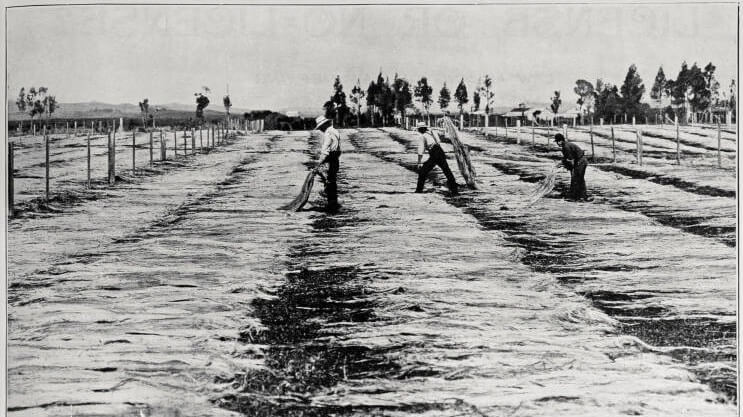
Mill hands spreading fibre to dry at Hairini, Te Awamutu.