

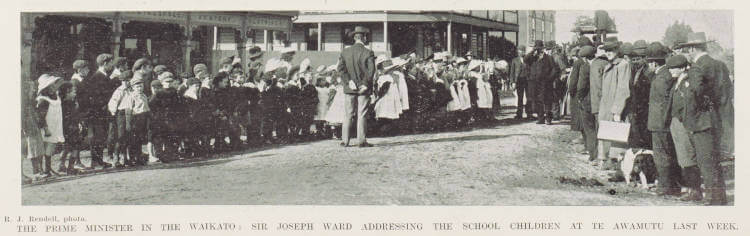
Prime Minister Sir Joseph Ward addresses schoolchildren before leaving for Kawhia.
The Prime Minister, Sir Joseph Ward, as part of his country tour, arrived at Te Awamutu by early train from Te Kūiti.
He and his party were driven to the Commercial Hotel, where they were entertained to breakfast by the Te Awamutu Town Board. After breakfast Sir Joseph received a number of deputations – the first being a request that Te Awamutu should be made a stopping station for the Main Trunk railway when the route was completed.
It was pointed out that Te Awamutu was the centre of a big farming district, and also possessed several historic battlefields. Several other requests included a government survey made between Te Awamutu and Kawhia for a railway to connect those two rapidly growing districts, a new front be provided for the Te Awamutu post office and an improved mail and telephone service for Kihikihi. All these requests met the reply that they would receive consideration. Despite the bureaucratic tone of the visit it was more successful than his next stop – Kawhia. Owing to bad roads and adverse tides it was very late when the party arrived. Consequently the tide was out, and a launch journey delayed. Then the launch, in trying a short cut to Kawhia, ran onto a sandbank, and had to be poled off.
The great mountain of Pirongia, covered to the summit with a dense growth of bush, was now being completely denuded by the settlers owning the greater part of it. The Government was opening a 45,000 acre block on what was called the Long Spur—all forest land.
Warnings were given about the effects of clearing the hillside. There would be a regular recurrence of too dry summer seasons. A great part of rainfall came over Pirongia, and the bush-covered mountain acted as a magnet in drawing down clouds which would otherwise pass over.
All geographers agreed that the wholesale clearing of forest was fraught with serious consequences for future rainfall. The Waikato could not live without a copious rainfall. The effects of a dry season on dairy cattle were so disastrous that whatever steps were necessary to obviate more severe droughts should be taken.
On a lighter note – ‘Extraordinary Weather’ was predicted for Ōhaupō It was expected great ‘clouds’ of people would ‘roll up’ to the hall; ‘showers’ of coin would fall into the ticket box; the ‘thunder’ of applause would greet the Te Awamutu Concert Party, and laughter and enjoyment would ‘reign’ supreme.
The saying ‘Everything comes to those who wait’ appeared to be perfectly true for the settlers of Te Rore who had long waited for a creamery to be built in their district. The chosen site was Mrs Totty’s farm. After a little delay in the erection of machinery, the newly built creamery started operations, everything working smoothly and in splendid order. A fair amount of milk was brought to the factory, and every day the quantity increased.
Mr C. Richdale secured the contract for the carting of the cream, and by this means Te Rore was brought into daily communication with Ōhaupō.